How to Build Muscle After 50: The 3-Day, 30-Minute Plan That Actually Works
If you’re over 50 and thinking about building muscle, you’ve probably heard some version of this before:
“You’re too old to build muscle.”
It’s one of the most common beliefs out there—and it’s completely wrong.
The truth is, you can absolutely build muscle after 50. In fact, it’s one of the best things you can do for your strength, your metabolism, your joints, and your long-term health.
What does change as you get older is how you approach it.
You don’t need to spend hours in the gym anymore. You don’t need complicated routines. And you definitely don’t need to train like you’re in your 20s.
What works best is a simple, focused approach that you can stick to consistently.
“Most people over 50 either train too hard and burn out, or not hard enough to see results.”
Who This Plan Is For
- Men over 50 who want to build muscle
- Beginners or those returning to training
- People short on time
- Anyone wanting a simple, sustainable routine
That’s exactly what this guide is about.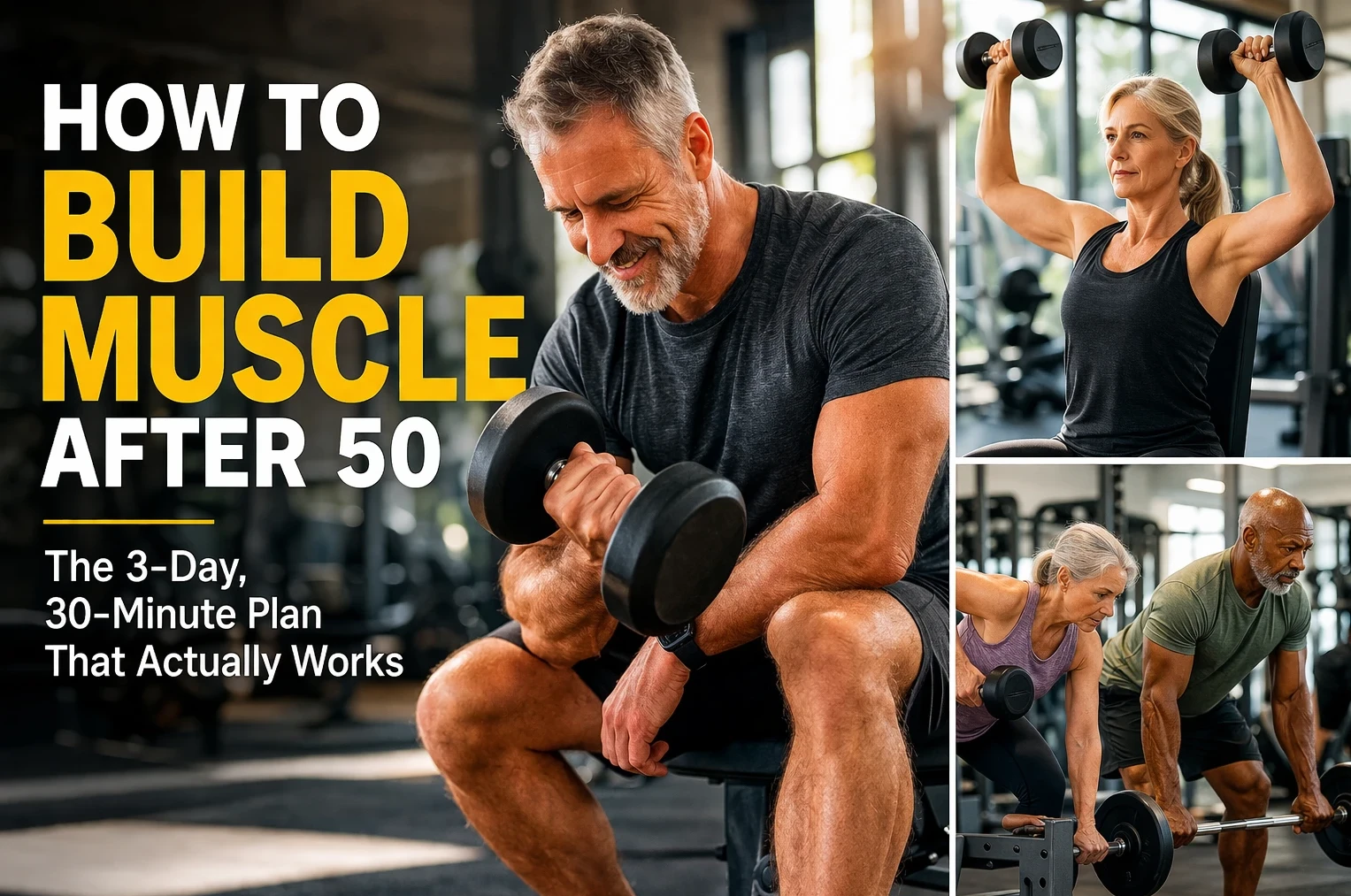
Why Building Muscle After 50 Feels Different
If you’ve tried training recently and felt like it’s harder than it used to be, you’re not imagining things.
A few key changes happen as we get older:
- Recovery takes longer
- Muscle loss naturally increases (this is called sarcopenia)
- Hormone levels decline slightly
- Joints can feel stiffer or more sensitive
None of this stops you from building muscle, but it does mean one thing:
You need to train smarter.
The biggest mistake most people make at this stage is either doing too much or not doing enough.
Some people jump into long, intense workouts and burn out or get injured. Others stay too light and never challenge their muscles enough to grow.
The sweet spot is somewhere in the middle—and that’s where a short, structured routine works extremely well.
The 3-Day, 30-Minute Muscle Building Plan
This is the exact style of training I use and recommend.
It’s simple, efficient, and it works.
You’re training three times a week, for about 30 minutes each session. That’s it.
Each workout focuses on a specific group of muscles, with just enough volume to stimulate growth without overdoing it.
Each workout use different exercises so you are working your muscles from different angles.
Go to failure on your last set.
It’s not flashy, but it’s effective—and more importantly, it’s sustainable.
Day 1: Legs
The goal here is to cover the main lower body muscles without turning it into a marathon session.
You only need three movements:
- One hamstring exercise (like Romanian deadlifts)
- One quad exercise (like squats or a leg press)
- One calf exercise (standing or seated calf raises)
Do 2–3 sets of each, somewhere in the 8–12 rep range
Go to close to failure on your last set.
That’s enough to challenge your muscles without overloading your joints or recovery.
A lot of people overcomplicate leg training. You don’t need five different quad exercises. You just need a few solid movements done well.
Day 2: Shoulders and Back
This session is all about upper body strength, posture, and balance.
For shoulders, you’re covering three key areas:
- A shoulder press (your main movement)
- A rear or side delt exercise (like reverse flys)
- A trap exercise (like shrugs)
Then for your back:
- A rowing movement (dumbbell, barbell, or machine)
- A pull-up or lat pulldown
This combination works well because it hits both the front and back of your upper body, which is important as you get older.
A strong back and shoulders make a big difference in posture, stability, and overall strength.
Day 3: Chest and Arms
This is your upper body “push” and arm-focused session.
For chest:
- One pressing movement (bench press or dumbbell press)
- One fly movement (floor flys or band crossover)
For arms:
- A bicep curl
- A triceps extension (or similar movement)
Again, keep it simple. You don’t need a dozen variations.
If you train these movements with control and consistency, you’ll see results.
How to Make This Routine Work
The routine itself is simple, but the way you approach it is what makes the difference.
Here are a few things that matter more than people realise.
Focus on Progress, Not Perfection
You don’t need to lift heavy right away.
What you do need is progression over time.
That might mean:
- Adding a bit of weight
- Doing one extra rep
- Improving your form
Small improvements each week add up quickly.
Keep Your Workouts Efficient
One of the biggest advantages of this approach is that it respects your time.
Thirty minutes is more than enough if you stay focused.
That means:
- Minimal distractions
- Controlled rest periods
- Moving with purpose
You’re not in the gym to pass time—you’re there to get a result.
Train Three Times Per Week
A simple schedule works best:
- Monday – Legs
- Wednesday – Shoulders and Back
- Friday – Chest and Arms
This gives your body time to recover between sessions, which becomes more important as you get older.
Nutrition Still Matters (Probably More Than You Think)
You can follow the best workout plan in the world, but if your nutrition is off, progress will be slow.
Protein is especially important.
As you age, your body becomes slightly less efficient at using protein, so you need to be more deliberate with your intake.
A good target is around 1.6 to 2.2 grams of protein per kilogram of body weight.
That doesn’t mean you need to overcomplicate things.
Focus on simple foods:
- Meat, fish, eggs
- Dairy like Greek yogurt
- Whole, unprocessed foods
If needed, a protein shake can help fill gaps, but it’s not essential.
Recovery Is Where Progress Happens
This is the part that gets overlooked the most.
You don’t build muscle while you’re training. You build it when you recover.
That means:
- Getting enough sleep
- Taking rest days seriously
- Not pushing through constant fatigue
If you’re always sore, always tired, or your strength is going backwards, that’s a sign you’re doing too much.
Pull things back slightly and let your body catch up.
Common Mistakes to Avoid
There are a few patterns that come up again and again.
One is doing too much volume. More exercises doesn’t mean more results.
Another is not pushing hard enough. If the weights are too light, your muscles don’t have a reason to grow.
Poor form is another issue. Especially as you get older, it’s not worth risking injury just to lift heavier.
And finally, inconsistency.
This is the big one.
A simple plan done consistently will always beat a perfect plan done occasionally.
Frequently Asked Questions
Can you really build muscle after 50?
Yes. This has been shown repeatedly in research and in real life. The body still responds to resistance training at any age.
Is 30 minutes really enough?
It is, as long as you’re focused.
Short, consistent workouts are much more effective than long, inconsistent ones.
How long before you see results?
Most people start to feel stronger within a few weeks. Visible changes usually take a couple of months.
What if I haven’t trained in years?
Start lighter, focus on form, and build up gradually.
There’s no rush.
Final Thoughts
If you’re over 50, building muscle isn’t about chasing extreme workouts or trying to keep up with younger lifters.
It’s about finding a system that works for your body and sticking with it.
This 3-day, 30-minute approach does exactly that.
It’s simple, it’s effective, and it’s realistic.
And that’s why it works.
If you stay consistent, focus on the basics, and give your body time to adapt, you’ll be surprised at what you can achieve.