Why You’re Not Losing Weight (It’s Not What You Think)
If you’ve been trying to lose weight for a while and not getting the results you expected, it can get frustrating pretty quickly.
You start thinking:
- Maybe I’m eating too much
- Maybe I need to train harder
- Maybe I just don’t have the discipline
But in a lot of cases, it’s not that.
It’s not that you’re lazy or doing nothing.
It’s that you’ve been focusing on the wrong thing.
Most people are told weight loss is all about calories.
Eat less, move more, and the weight will come off.
And while that sounds simple, it doesn’t always work like that in the real world.
Because your body isn’t just counting calories.
It’s responding to hormones.
And one of the most important of those hormones is insulin .
Watch this video by Dr Ben Bikman author of Why We Get Sick
Let’s Keep This Simple: What Insulin Actually Does
You don’t need a science background to understand this.
Just think of insulin like a switch.
When insulin is high:
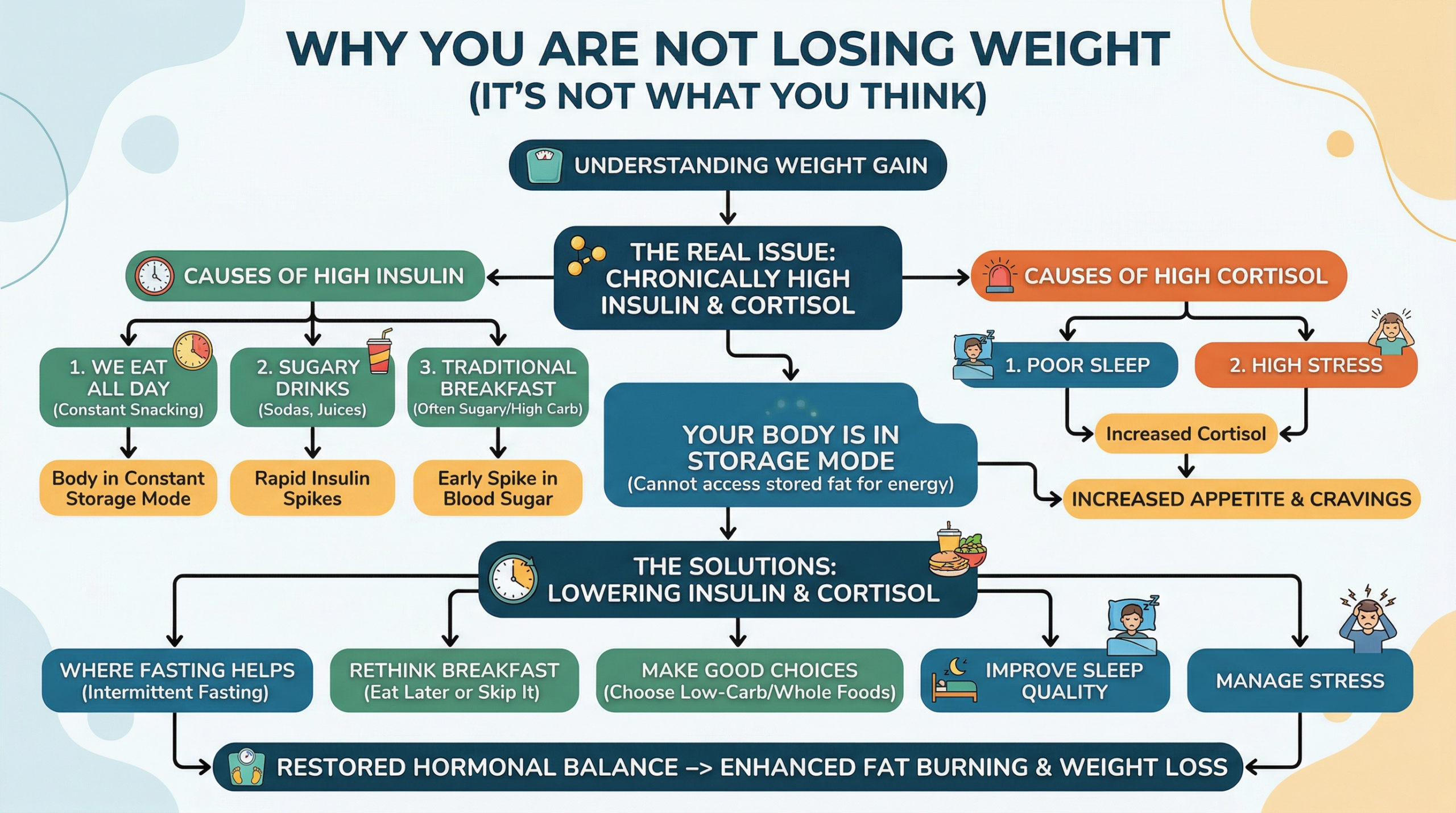
Your body is in storage mode
When insulin is low:
Your body is in fat-burning mode
That’s the easiest way to look at it.
Now here’s the important part.
As explained in the transcript, fat cells don’t actually grow unless insulin is present—even if there are plenty of calories around .
That means calories alone aren’t the full story.
You could have energy available, but without insulin, your body doesn’t store it the same way.
Why Some People Struggle (Even When They’re Trying)
This is where things start to make more sense.
You’ve probably seen people:
- Eating less
- Doing more cardio
- Trying really hard
And still not losing weight.
That’s usually because insulin is staying elevated too often.
When that happens:
- Your body holds onto fat
- It doesn’t easily access stored energy
- Progress slows down
So it’s not just about effort.
It’s about what’s happening internally.
The Real Issue: We Eat All Day
If you look at how most people eat now, it’s very different to how it used to be.
It’s not just:
- Breakfast
- Lunch
- Dinner
It’s:
- Snacks in between
- Something while watching TV
- A coffee with something on the side
- A bit of this, a bit of that
All of that adds up.
And every time you eat, insulin rises.
So instead of going up and down during the day…
It stays elevated most of the time
And when insulin stays high, your body stays in storage mode.
This Is Where Fasting Helps
Now fasting can sound a bit extreme when people first hear it, but it’s really not.
All it means is:
You give your body a break from eating
When you’re not eating:
- Insulin drops
- Your body starts using stored energy
That’s the shift.
Instead of constantly putting energy in…
You give your body time to use what’s already there
The Morning Is Where Most People Get It Wrong
This is something that surprised me when I first came across it.
Most people think:
“Wake up → eat breakfast straight away”
But your body doesn’t always work best like that.
In the early morning, your body naturally releases cortisol.
This is part of your internal clock—it helps wake you up and get you moving.
But it also:
- Raises blood sugar
- Affects insulin
Which means your body can be a bit more insulin resistant in the morning .
What that means in real life
If you wake up and immediately eat something like:
- Toast
- Cereal
- Something sugary
You’re stacking:
- High blood sugar
- High insulin
Right at the start of the day.
And that can make it easier for your body to store fat instead of using energy.
A Better Way to Start the Day
You don’t need to do anything extreme here.
Just don’t rush.
Instead of waking up and going straight to food, try:
- Getting up and moving around
- Going for a walk
- Starting your day
Let your body wake up properly.
You’ll often find:
You’re not actually that hungry straight away
Rethinking Breakfast (This Is a Big One)
If you do eat breakfast, just think about what you’re eating.
A lot of “normal” breakfasts now are basically desserts.
- Sugary cereal
- Toast with jam
- Pastries
They spike insulin quickly.
A better approach is simple:
Keep it balanced
Focus on protein and whole foods
Or even:
Delay it slightly if you’re not hungry
Sleep and Stress Play a Bigger Role Than You Think
This is something people often overlook.
If you’re not sleeping well, your body treats that as stress.
That raises cortisol.
And as mentioned in the transcript, higher cortisol can:
- Increase appetite
- Increase cravings (especially for carbs)
- Make it harder to stay on track
So if you’re:
- Tired
- Stressed
- Running on low sleep
It’s not just in your head.
Your body is working against you a bit.
Even Coffee Can Have an Effect
This one catches people off guard.
Coffee itself isn’t the problem.
But when you combine it with:
- Sugar
- Carbs
It can increase the insulin response.
Especially first thing in the morning when your body is already in that elevated state.
You don’t need to cut it out.
Just be aware of how you’re using it.
Keep This Practical (This Is What Actually Works)
You don’t need to overcomplicate this.
You don’t need a strict plan or perfect timing.
Start with a few simple changes:
- Stop eating constantly throughout the day
- Give your body a break between meals
- Don’t rush straight into a sugary breakfast
- Focus on whole foods
- Get enough sleep
That’s it.
You don’t need more than that to start seeing a difference.
How This Fits With What You’re Already Doing
This works perfectly alongside your current approach.
You’ve already got:
- A simple workout structure
- A focus on consistency
- A practical way of eating
This just adds another layer:
Understanding how your body responds to food timing
Your Training Still Matters
Strength training is still one of the best things you can do.
It helps:
- Maintain muscle
- Support metabolism
- Improve overall health
Your 3-day, 30-minute routine fits perfectly here.
Short, focused, and effective.
The Big Takeaway (Keep This in Mind)
If there’s one thing to remember, it’s this:
It’s not just about how much you eat
It’s about what your body is doing with it
And insulin plays a big role in that.
Final Thoughts
You don’t need to make this complicated.
You don’t need extreme diets or long workouts.
What works is:
- Simple nutrition
- Better timing
- Consistency
Once you understand what’s going on, things start to make more sense.
And when things make sense, they’re much easier to stick to.
- Link to my Fasting post
- Link to my Workout for Over 50s post
- Link to my 5 Step weight loss plan
- Link to my Weight Loss category