
T
Strength Training for Women Over 50: Benefits, Myths, and a Simple Plan That Works
If you’re a woman over 50, strength training might feel a bit intimidating at first.
You might be wondering:
- Is it safe?
- Do I really need to lift weights?
- Where do I even start?
I get it. A lot of people still think strength training is only for younger people or bodybuilders.
But the reality is, it’s one of the most important things you can do for your health as you get older.
This isn’t about getting bulky or spending hours in the gym.
Many women who start strength training later in life say it is one of the best things they have done.
It’s about staying strong, maintaining muscle, and keeping your body working the way it should.
And the good news is—you don’t need to overcomplicate it.
Why Strength Training Becomes More Important After 50
As you get older, your body naturally starts to change.
You lose muscle more easily. Bone density can decrease. Your metabolism can slow down.
That’s just part of the ageing process.
But here’s the key point:
You can slow or even reverse a lot of that with strength training
When you lift weights or use resistance in any form, your body adapts.
- Muscles get stronger
- Bones become more dense
- Your body becomes more capable overall
It’s not about trying to turn back the clock.
It’s about keeping your body strong and functional for as long as possible.
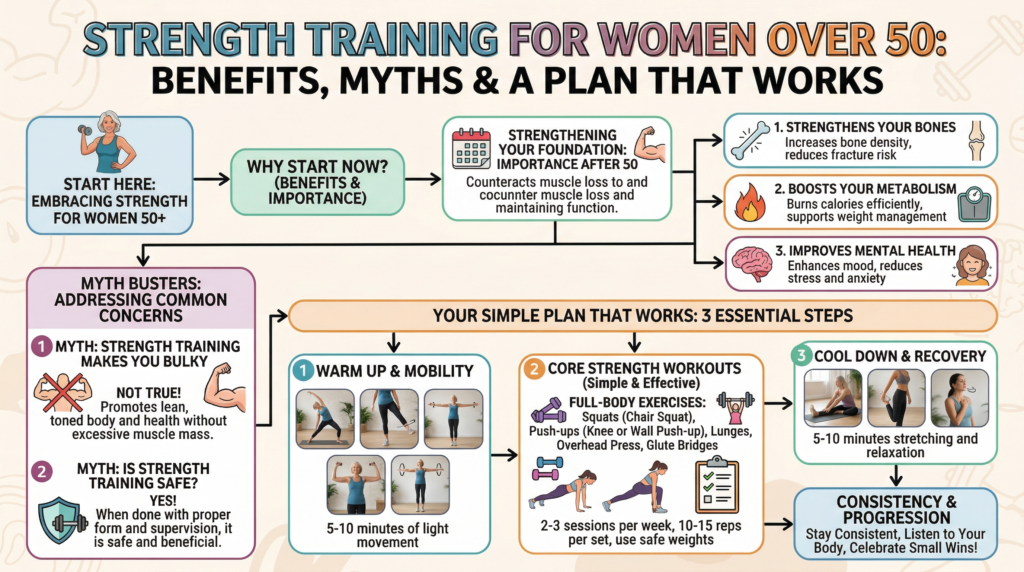
Let’s Clear Up a Common Myth
One of the biggest concerns women have is this:
“I don’t want to get bulky”
That’s not something you need to worry about.
Building large amounts of muscle requires very specific training and nutrition.
What strength training actually does for most women is:
- Improve muscle tone
- Increase strength
- Help shape the body
You’ll feel stronger, move better, and generally feel more capable in day-to-day life.
Stronger Bones (This Is a Big One)
One of the biggest benefits of strength training—especially after 50 is bone health.
Conditions like osteoporosis become more common with age, particularly for women.
Strength training helps by putting controlled stress on your bones.
That might sound like a bad thing, but it’s actually how bones get stronger.
Your body responds by increasing bone density.
Over time, this can:
- Reduce the risk of fractures
- Improve stability
- Help you stay active and independent
It Helps Your Metabolism Too
Another big benefit is what it does for your metabolism.
Muscle burns more energy than fat.
So the more muscle you maintain, the more calories your body uses—even at rest.
That doesn’t mean you need to chase muscle growth.
It just means:
Maintaining muscle makes everything else easier
Especially when it comes to weight management.
This also ties in closely with your nutrition and weight loss approach—the two work together.
It’s Not Just Physical—It Helps Mentally Too
This is something people often don’t expect.
Strength training doesn’t just change your body—it changes how you feel.
Regular training can help:
- Reduce stress
- Improve mood
- Increase confidence
There’s something about getting stronger that carries over into everyday life.
You feel more capable.
More in control.
And that makes a difference.

A Simple Strength Training Plan That Actually Works
This is where most people get stuck.
They think they need a complicated program or hours in the gym.
You don’t.
The approach I recommend is simple.
The 3-Day, 30-Minute Method
Three workouts per week.
Each one around 30 minutes.
Day 1: Legs
- One hamstring exercise
- One quad exercise
- One calf exercise
Day 2: Shoulders and Back
- One front delt exercise
- One rear delt or side delt exercise
- One Trapezius exercise
- One Lats exercise
Day 3: Chest and Arms
- One chest press exercise
- One chest fly exercise
- One bicep exercise
- One triceps exercise
That’s it.
Short, focused sessions.
No unnecessary exercises.
How to Train
You don’t need to do endless sets.
Keep it simple:
- 2–3 sets per exercise
- 8–12 reps
- Final set pushed close to failure
The goal isn’t to exhaust yourself.
It’s to challenge your muscles enough to create progress.
Recovery Is Just As Important
This is where a lot of people go wrong.
They think more is better it’s not.
But especially after 50:
Recovery matters just as much as training
That’s why this 3-day structure works so well.
It gives your body time to:
- Repair
- Adapt
- Get stronger
Common Mistakes to Avoid
If you want to get results, avoid these:
1. Doing too much cardio
Cardio has its place, but relying on it alone isn’t the best approach.
Strength training should be the foundation.
2. Not lifting heavy enough
If it feels too easy, it probably is.
You need to challenge your muscles.
3. Inconsistency
This is the biggest one.
You don’t need perfect workouts.
You just need to show up regularly.
What Results Should You Expect?
This is important to understand.
You won’t see everything change overnight.
What you’ll notice first is:
- Increased strength
- Better energy
- Improved confidence
Then over time:
- Better muscle tone
- Improved body composition
- More stability and balance
It builds gradually.
But it builds.
How This Fits With Your Overall Health
Strength training doesn’t exist on its own.
It works best when combined with:
- Simple nutrition
- Consistent habits
- Enough recovery
If you’re working on weight loss, this supports it.
If you’re focusing on overall health, it improves everything.
Getting Started (Keep It Simple)
You don’t need the perfect setup.
You can start with:
- Light dumbbells
- Resistance bands
- Basic machines
Focus on:
- Learning good form
- Building consistency
- Gradually increasing effort
That’s what makes the difference.
Final Thoughts
You don’t need to overthink this.
You don’t need long workouts or complicated routines.
What works is:
- A simple plan
- Consistent effort
- Enough recovery
Strength training after 50 isn’t about pushing harder.
It’s about training smarter.
Start small, stay consistent, and let the results build over time.