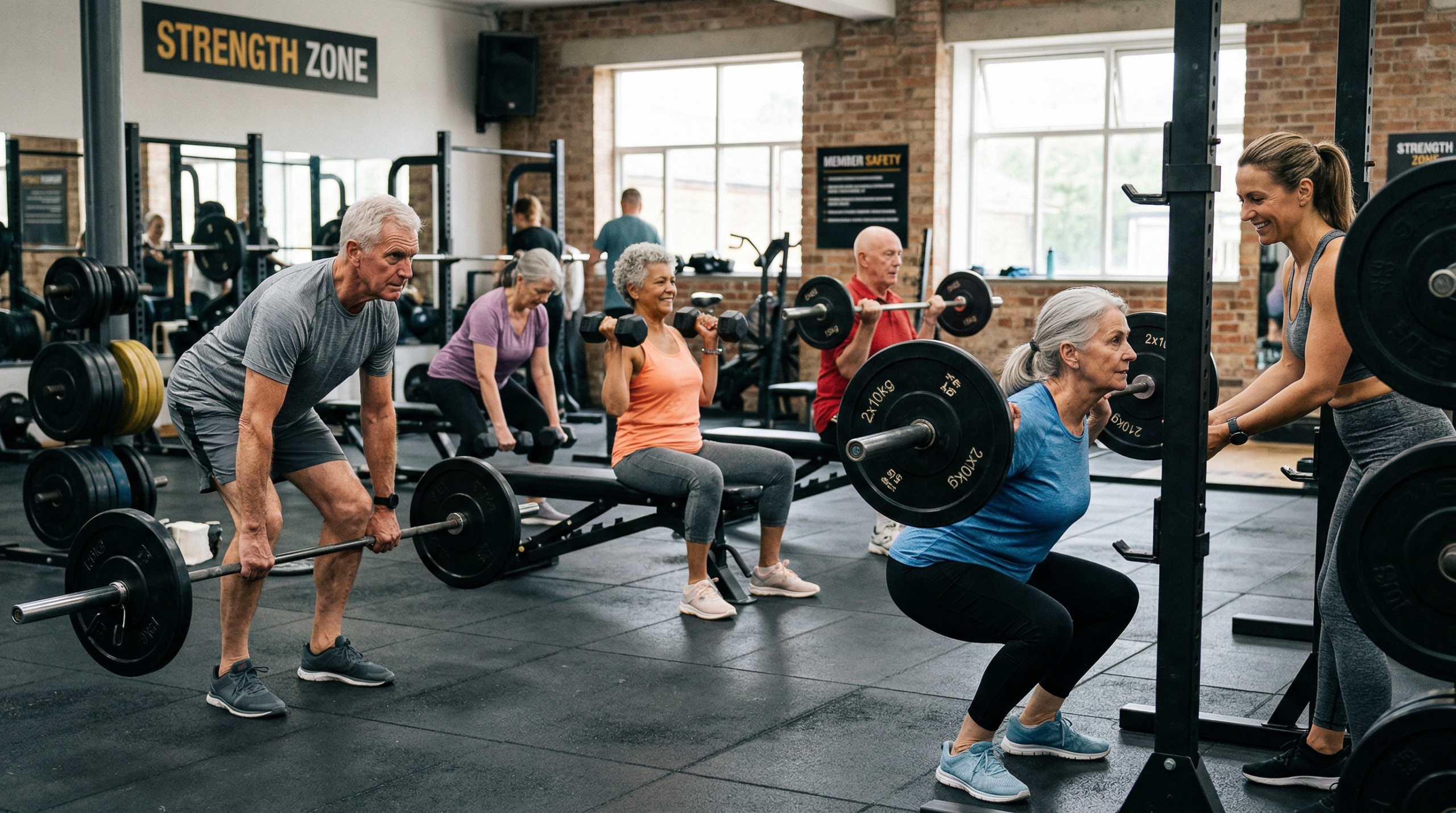
If you’re over 50, you’ve probably heard it before:
“You can’t build muscle at your age.”
That belief is outdated — and scientifically incorrect.
Muscle growth remains possible well into your 50s, 60s, and beyond. While aging changes how your body responds to training, the biological mechanisms that drive hypertrophy still work.
The key is training intelligently.
Can You Build Muscle After 50?
Yes, you can build muscle after 50 with the right training and nutrition. While progress may be slightly slower than in your younger years, your body still responds to resistance training and protein intake.
I’ve personally increased my strength and muscle mass starting at 64. What I found works best is not long, exhausting workouts, but short, focused sessions done consistently.
The key is training smart, recovering well, and staying consistent.
What Happens to Muscle After 50?
Starting around age 30, muscle mass gradually declines. After 50, this process accelerates. This age-related loss of muscle is called sarcopenia.
Without resistance training, adults may lose:
- 3–8% of muscle mass per decade
- Strength at an even faster rate
- Bone density
- Metabolic efficiency
But here’s the important part:
Sarcopenia is largely inactivity-driven — not age-driven.
When muscles are stimulated through resistance training, they respond. This is why strength training over 50 becomes essential (see: https://jrhealthandfitness.com/strength-training-for-over-50s/).
Why Building Muscle After 50 Matters
Muscle is not just cosmetic tissue. It directly impacts:
- Metabolic rate
- Blood sugar regulation
- Fat loss efficiency
- Bone density
- Balance and fall prevention
- Long-term independence
Maintaining lean mass is one of the most powerful longevity tools available.
If fat loss is also your goal, muscle preservation is critical (see: https://jrhealthandfitness.com/weight-loss-for-over-50s/).
5 Keys to Building Muscle After 50
- Strength train 3 times per week
- Consume 1.6–2.2g protein per kg bodyweight
- Focus on compound movements
- Prioritize recovery and sleep
- Progress weights gradually
These principles remain the foundation at any age.
How Much Protein Do You Need After 50?
As we age, muscles become slightly less responsive to protein intake — a process called anabolic resistance.
Because of this, protein needs increase slightly.
Recommended Intake:
- 1.6–2.2 grams per kilogram of bodyweight
- Spread across 3–4 meals
- 30–40g per meal target
Example Protein Targets
Bodyweight Daily Protein Target70kg (154lb)110–150g80kg (176lb)125–175g90kg (198lb)145–200g
For a deeper breakdown, see:
https://jrhealthandfitness.com/protein-requirements-for-over-50s/
Without adequate protein, muscle growth becomes significantly harder — even with consistent training.
The Best Training Approach After 50
Muscle grows through:
- Mechanical tension
- Progressive overload
- Adequate volume
- Recovery
The principles don’t change. The structure does.
1. Prioritize Compound Movements
Compound exercises stimulate more muscle mass and preserve functional strength.
Examples:
- Squats
- Deadlifts
- Rows
- Presses
- Pull variations
Exercise ideas:
https://jrhealthandfitness.com/muscle-building-exercises-for-over-50s/
2. Train in Moderate Rep Ranges
6–12 reps per set
2–4 sets per exercise
3–4 sessions per week
Very heavy max lifts are unnecessary. Controlled progressive loading works extremely well.
3. Use Progressive Overload
Progress can mean:
- Adding 2.5kg
- Increasing reps
- Adding a set
- Improving form
Small weekly improvements compound dramatically over time.
Sample Weekly Training Plan (Over 50 Beginner)
Day 1 – Upper Body
- Bench press or push-ups – 3×8
- Seated row – 3×10
- Shoulder press – 3×8
- Biceps curls – 2×12
- Triceps extensions – 2×12
Day 2 – Lower Body
- Squats or leg press – 3×8
- Romanian deadlift – 3×10
- Step-ups – 2×12
- Calf raises – 3×15
Day 3 – Rest or active recovery
Day 4 – Repeat Upper
Day 5 – Repeat Lower
This provides frequency without overtraining.
Recovery Becomes More Important After 50
Muscle grows during recovery — not during workouts.
Prioritize:
- 7–9 hours sleep
- Sufficient protein
- Light activity on rest days
- Mobility work
If you want to reduce injury risk, see:
https://jrhealthandfitness.com/how-to-prevent-injuries-during-exercise/
Common Mistakes After 50
1. Too Much Cardio
Excess steady-state cardio can interfere with muscle gain.
Strength should be the foundation.
Comparison:
https://jrhealthandfitness.com/weightlifting-vs-cardio-for-fat-loss/
2. Undereating Protein
Most adults over 50 eat far less protein than needed.
This severely limits hypertrophy.
3. Avoiding Heavy Training Entirely
Moderate-to-heavy loads preserve:
- Bone density
- Strength
- Neuromuscular coordination
4. Not Tracking Progress
If nothing increases, muscle does not grow.
Hormones and Muscle Growth After 50
Testosterone and growth hormone decline gradually with age.
However:
Hypertrophy is primarily driven by mechanical tension and nutrition — not hormone levels alone.
Resistance training improves insulin sensitivity and metabolic function at any age.
Women benefit significantly from resistance training, especially for bone density and body composition:
https://jrhealthandfitness.com/benefits-of-resistance-training-for-women/
Can You Build Muscle and Lose Fat After 50?
Yes — especially if you are new to resistance training.
This is called body recomposition.
It requires:
- High protein intake
- Progressive strength training
- Moderate calorie control
- Consistency
Crash dieting undermines muscle preservation.
A sustainable approach works best:
https://jrhealthandfitness.com/creating-a-sustainable-weight-loss-plan/
How Long Does It Take to See Results?
- Strength gains: 2–4 weeks
- Visible muscle changes: 8–12 weeks
- Significant transformation: 6–12 months
Consistency beats intensity.
Frequently Asked Questions
Is 50 too old to build muscle?
No. Adults over 50 can increase muscle mass and strength with proper resistance training and protein intake.
How often should someone over 50 lift weights?
3–4 sessions per week allows optimal stimulus and recovery.
Should you lift heavy after 50?
Yes, within safe limits. Moderate-to-heavy loads preserve bone density and muscle mass.
Is it harder to build muscle after 50?
It can be slightly slower due to anabolic resistance, but muscle growth remains fully achievable.
Final Thoughts
You are not too old to build muscle.
You are undertrained.
Muscle growth after 50 is not just possible — it is one of the most powerful investments you can make in your long-term health.
Strength supports:
- Metabolism
- Bone density
- Fat loss
- Balance
- Independence
Start small. Progress gradually. Stay consistent.
Your body still adapts.