
Quick picks: best for balance, small spaces, budget and heavier users
The best rebounders for seniors over 50 are the ones that match a specific need. Balance, available space, budget and body weight each point to a different type of rebounder, so the quick picks below are organised by need. The sections after them explain the reasoning, so you can check the pick against your own situation.
- Best for balance: a rebounder with a stability bar, a solid (non-folding) frame and bungee cords. The bar gives your hands something to hold, the rigid frame does not flex, and the bungee suspension is gentle underfoot.
- Best for small spaces: a folding rebounder with a stability bar that can also be detached or folded. It trades a little rigidity for storage that fits behind a door or under a bed.
- Best budget: a basic spring rebounder without extras. Springs are inexpensive to build and last well, but they are firmer and louder, so the saving comes with compromises.
- Best for heavier users: a solid-frame rebounder with a high stated weight limit, a wide mat and a reinforced frame. The weight limit on the label matters more than anything else on the box.
Each of these gets a full verdict later in the article, with who it suits, what it does well and where it falls short.
Before you buy: a short note on affiliate links and checking with your doctor
Some links on this page may be affiliate links. If you buy through one, the site may earn a commission, and the price you pay stays the same. The comparisons below are written to help you choose the right type of rebounder, including cases where the right choice is the cheaper one or no purchase at all.
A rebounder is gentle compared with many forms of exercise, but it is still a moving surface under your feet. Talk to your doctor or physiotherapist before you start, especially if any of these apply to you:
- You have had falls, dizziness or episodes of unsteadiness.
- You have osteoporosis or low bone density.
- You have had a hip, knee or ankle replacement, or recent surgery.
- You have a heart condition, high blood pressure or take medication that affects your balance.
- You have pelvic floor concerns, since bouncing changes the load on those muscles.
- You have an inner ear condition or vertigo.
A useful question to take to the appointment is whether you can do a gentle bounce, where your feet stay on the mat, or whether walking in place on the mat is the safer starting point. Your doctor knows your history, and a comparison article does not.
Folding vs solid frame: which suits your home and your body
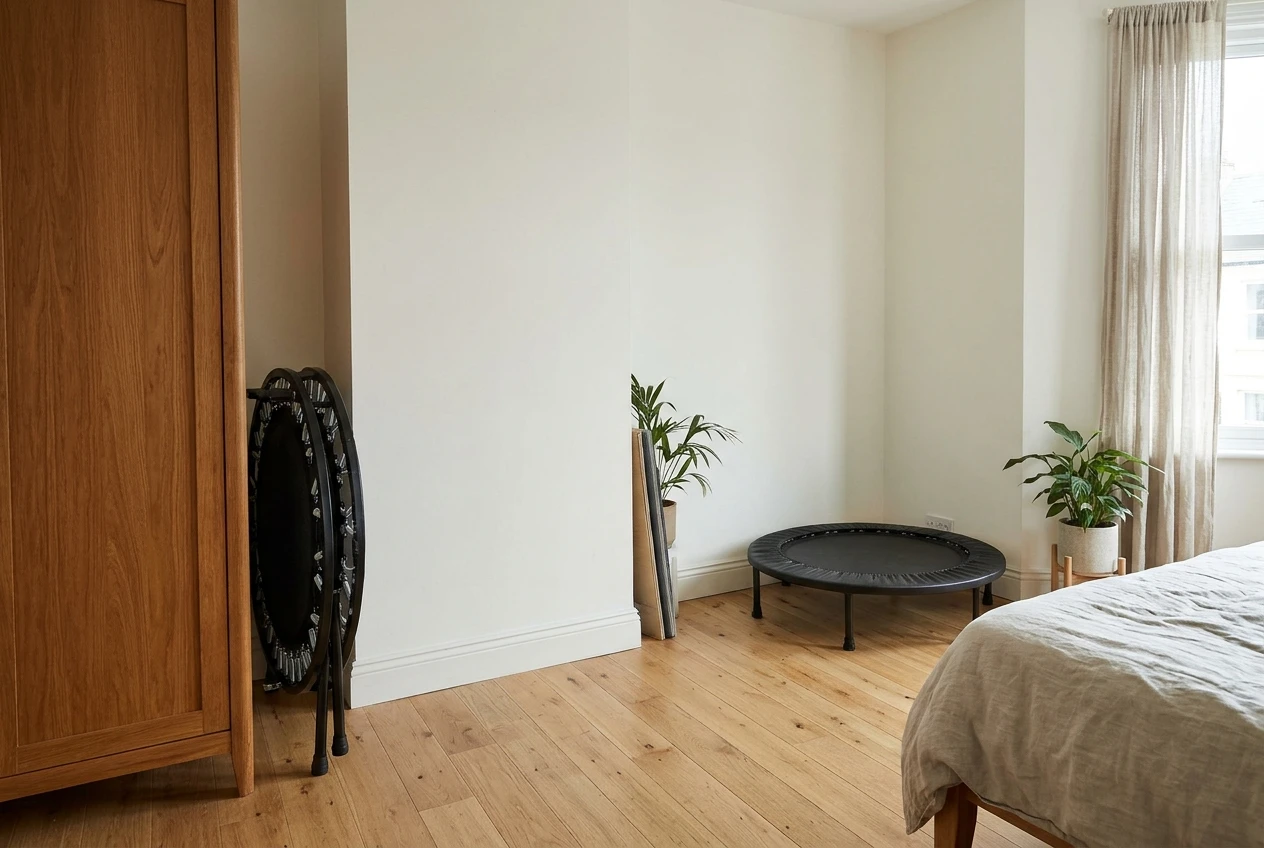
The first decision is the frame. A folding rebounder has hinged legs and a frame that collapses, usually in half. A solid frame is one rigid piece, and some solid models have legs that unscrew or detach.
Solid frame: the steadier choice
A solid frame has no hinges, so there is no joint that can loosen or wobble over time. Every bounce goes straight into a structure that does not move, which feels more predictable under your feet. For anyone whose main concern is balance, this is the more reassuring build.
The cost is storage. A solid rebounder stays assembled, so it needs a permanent spot in a corner, a spare room or a hallway. If you plan to use it most days and have a space where it can stay out, this is rarely a problem.
Verdict: best for balance and for people who can leave it set up. Suits: those who want maximum stability and have floor space. Pros: rigid, no hinge to loosen, steady feel. Cons: takes up room permanently, harder to move when assembled.
Folding frame: the space-saver
A folding rebounder collapses so it can be slid into a cupboard, behind a sofa or under a bed. For flats and shared homes where floor space is limited, that can decide whether the rebounder gets used at all.
The hinges are the weak point. Check that the locking mechanism is secure when open and that the legs do not shift under your weight. A folding frame that is fully locked and set on a flat floor can be perfectly safe, but you need to confirm it locks every time, because a half-locked hinge is a hazard for anyone with balance concerns.
Verdict: best when storage is the limiting factor. Suits: small homes, occasional users, people who want to put it away after each session. Pros: compact, easy to store, often lighter to carry. Cons: hinges need checking, may feel less rigid, a locking step before each use.
Stability bar or no stability bar: what it changes for balance
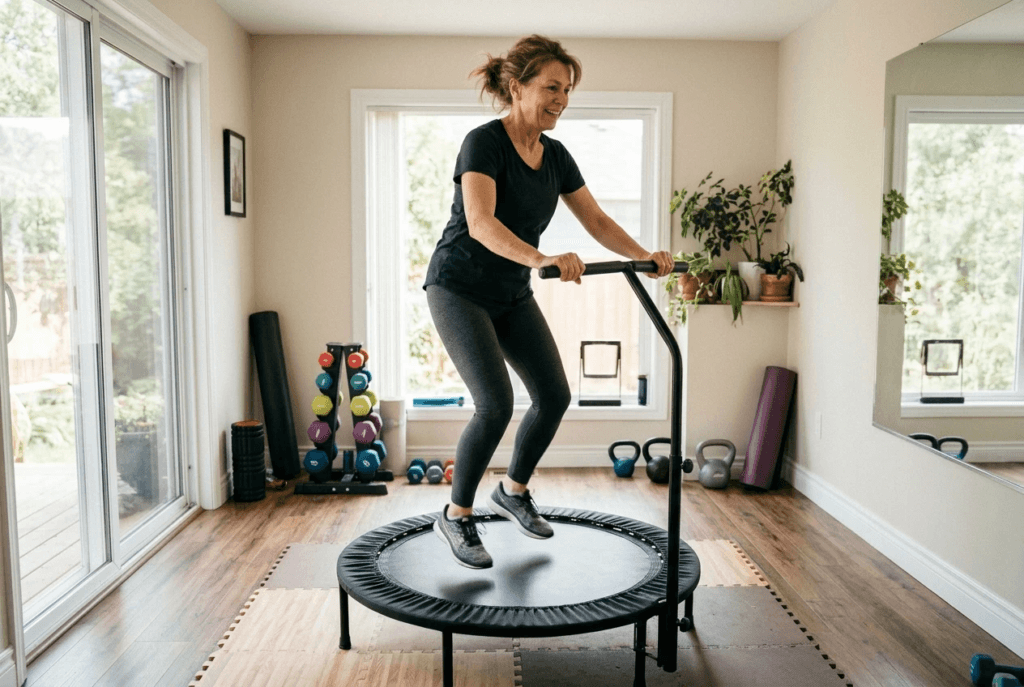
A stability bar is a handle that attaches to the frame, usually as a T-shape or a U-shape standing at waist height. You hold it while you bounce or walk on the mat.
For anyone over 50 who is nervous about balance, the bar is the most important accessory. It lets you steady yourself when the mat moves, build confidence in the first few weeks and recover quickly if you wobble. It also means you can start with very small movements, such as heel lifts or walking in place, without worrying about stepping off the edge.
Check these features before relying on a bar:
- Height adjustment. The bar should sit around your waist so you can hold it without hunching or reaching up.
- Secure attachment. It should lock firmly into the frame without any play or rattle.
- Padded grips. Padding makes it more comfortable to hold, especially if your hands or wrists are sore.
- Stable base. A bar only helps if the whole rebounder stays put, so look for non-slip feet on the frame.
Going without a bar suits people who already have very good balance and want a freer movement range. Even then, some people prefer to have the option, and many bars can be removed. If you are unsure, choose a model with a removable bar. You can take it off later, and you cannot always add one afterwards, because it depends on the frame being designed to accept it.
Verdict: a stability bar is strongly worth having for most over-50 buyers, and essential for anyone with balance concerns. Suits: nearly everyone starting out. Pros: support, confidence, safer entry and exit. Cons: adds a little cost and takes up some extra room, and a poorly attached bar can rattle.
Bungee vs spring: feel, noise and joint comfort compared
The suspension is what connects the mat to the frame, and it decides how the rebounder feels, sounds and treats your joints.
Bungee (elastic cord) suspension
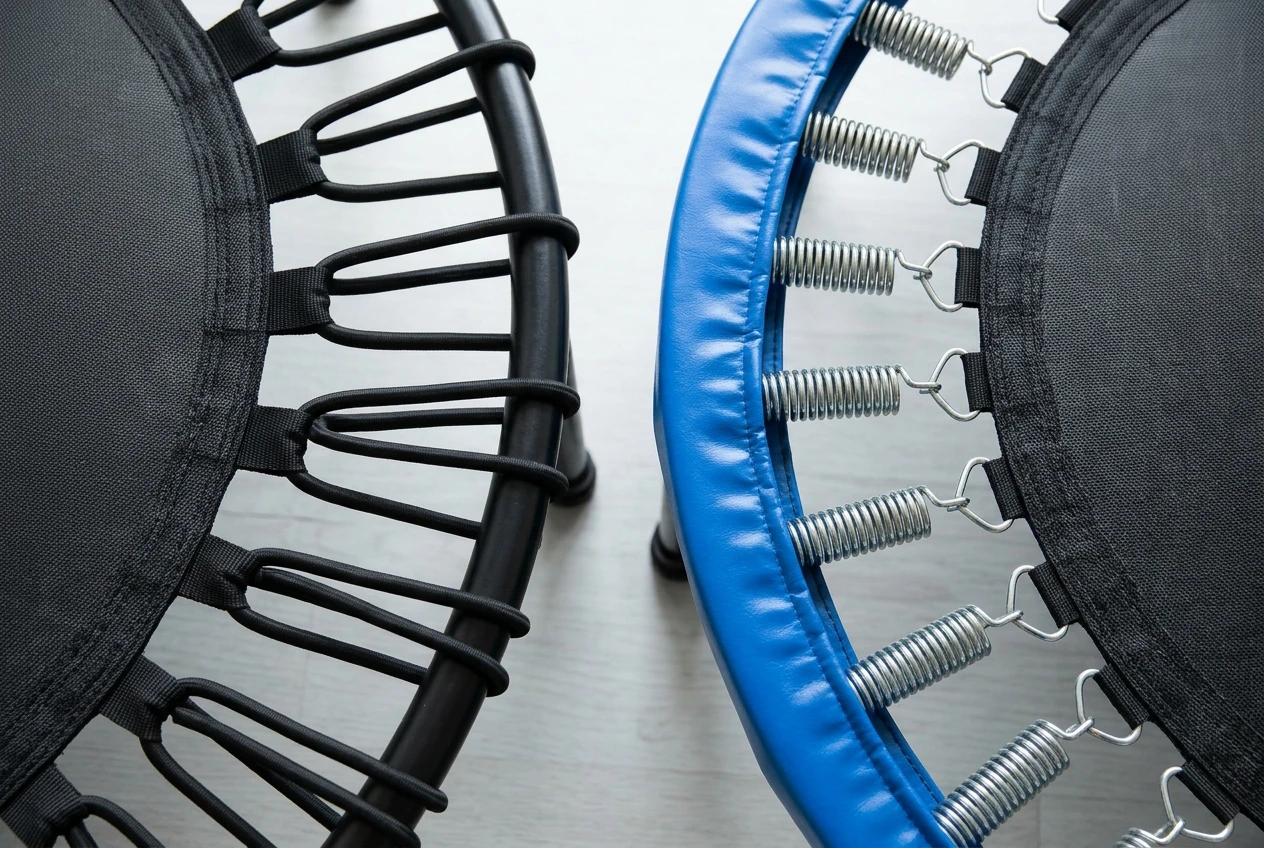
Bungee rebounders use elastic cords to hold the mat. The ride is softer and more cushioned, and the bounce is smoother with less of a sudden stop at the bottom. Because the cords absorb movement quietly, these models tend to make less noise than spring versions.
That softer feel is generally more comfortable on knees, hips and ankles. It also means the mat gives more as you step, which can feel unusual at first. Cords can stretch and perish over time, so check whether replacements are available and how easy they are to fit.
Verdict: best for joint comfort and quiet use. Suits: people with sensitive joints, those living in flats or sharing walls, and anyone exercising early or late. Pros: gentle, quiet, smooth. Cons: cords wear and need replacing eventually, and the softer mat takes some adjusting to.
Spring suspension
Spring rebounders use metal coils around the edge of the mat. The bounce is firmer and more responsive, and the mat returns to flat quickly. Springs are tough and tend to last, and they usually cost less to make, which can mean a lower price.
The trade-offs are noise and impact. Springs can squeak or twang, especially as they age or if they are not lubricated, and the firmer rebound puts more load through the joints. Springs also need a cover around the edge, so check that a padded cover sits over them to protect your feet and shins.
Verdict: best where budget matters more than quiet. Suits: people without joint trouble, those with a spot where noise does not matter, and users who want a lively bounce. Pros: durable, firm, often cheaper. Cons: louder, harder on joints, needs a good padded cover.
Size, weight limits and noise: the specs worth checking
Product pages carry a long list of numbers. A few of them affect safety and comfort, and the rest are marketing.
Weight limit. This is the maximum user weight the manufacturer states. Choose a rebounder with a limit comfortably above your body weight, because a rebounder working near its limit will feel less stable and wear out sooner. If a listing does not state a weight limit, treat that as a warning.
Mat size. A wider mat gives your feet more room and a bigger margin for error if you step off-centre. A wider mat also means a bigger rebounder, so balance this against how much space you have.
Frame height. A lower rebounder is easier to step onto and off. If you use a stability bar, a lower frame also keeps the bar at a comfortable height.
Padding and cover. The cover over the springs or the frame edge should be thick and fixed in place, so you do not catch a foot on a bare metal part.
Non-slip feet. Rubber caps on the legs stop the rebounder sliding on hard floors. If your floor is smooth tile or laminate, a mat underneath the legs adds a second layer of grip.
Noise. Product pages often claim a model is quiet. Treat this as a general guide and check customer comments for mentions of squeaking, creaking or thumping, particularly from people living in flats. Bungee suspension is the more dependable route to a quieter bounce.
Weight of the rebounder. If you plan to move it often, the carrying weight matters. A heavier frame is usually sturdier, and a lighter one is easier to shift. Decide which of those you value more.
Best for balance: a stability bar, solid frame, bungee rebounder
Verdict: the strongest choice for anyone who wants to feel secure. This combination removes the three most common sources of wobble: a hinge that might shift, a firm mat that jolts, and no handle to hold.
Who it suits:
- People who feel unsteady on their feet or are returning to exercise after a break.
- Anyone who has been told by a doctor or physiotherapist to build balance gradually.
- Users who want to start with walking in place and progress slowly.
What to look for:
- A bar with adjustable height and padded grips, fixed firmly to the frame.
- A rigid frame with non-slip feet.
- Bungee cords, which give a softer response.
- A mat wide enough for your feet to sit comfortably apart.
Pros: the most stable setup, gentle on joints, quiet, and easy to build confidence on.
Cons: it needs permanent floor space, it usually costs more than a basic spring model, and the soft mat takes a few sessions to get used to.
When you find a model that matches this description, use the “Check the current price and features” link to confirm the weight limit, bar height range and cord replacement options before buying.
Best for small spaces: a folding rebounder with a removable bar
Verdict: the practical choice when floor space is tight. A folding frame that collapses flat can live in a cupboard or behind a door and come out only when you need it.
Who it suits:
- People in flats, small houses or shared homes.
- Anyone who prefers to put equipment away so the room stays clear.
- Occasional users who want a short session a few times a week.
What to look for:
- Hinges with a clear, positive lock that you can see and feel engage.
- A stability bar that attaches securely and can be removed for storage, or one that folds with the frame.
- A folded size that fits the spot you have in mind. Measure the space before you order.
- A carrying handle or a weight you can lift comfortably.
Pros: easy to store, simple to move, and it keeps a small room usable.
Cons: the hinges need a quick check every time you set it up, it can feel slightly less rigid than a solid frame, and if you have significant balance concerns, a solid frame is still the steadier option.
If balance is your top priority and space is your second, consider whether you could keep a solid frame in a corner before settling on a folding one.
Best budget: a basic spring rebounder
Verdict: a sensible option if cost is the main limit and you have no major joint or noise concerns. Springs are tough, simple and usually the cheapest suspension to buy.
Who it suits:
- People trying a rebounder for the first time who want to see whether they will use it.
- Users without sensitive knees, hips or ankles.
- Homes where noise is not an issue, such as a ground-floor room or a detached house.
What to look for:
- A thick, secure padded cover over every spring.
- A stated weight limit that is comfortably above your weight.
- Non-slip feet and a frame that does not flex.
- A stability bar if one is offered, even if it costs a little extra. At this price point, it is the single upgrade that adds the most safety.
Pros: lowest cost, durable construction, a firm, responsive bounce.
Cons: louder than bungee, harder on the joints, and some budget models skimp on padding or the bar. Be cautious about any very cheap model that does not state its weight limit clearly.
A budget model that is stable and well padded is a better buy than a more expensive one that wobbles. Spend the savings on a bar if you can.
Best for heavier users: a solid frame with a high weight limit
Verdict: the right choice when body weight is a consideration. A rebounder used close to its limit flexes more, wears faster and feels less secure, so a solid, reinforced build with generous headroom on the weight limit makes the biggest difference.
Who it suits:
- Anyone whose weight is near the limit of standard rebounders.
- Users who want extra reassurance about the frame holding up.
- People who plan to exercise regularly and want a model that lasts.
What to look for:
- A clearly stated weight limit well above your weight, not just a vague “heavy duty” claim.
- A solid, one-piece frame, or a folding frame with robust locking hinges, if you need to store it.
- A wide mat, which gives more room for your feet and makes the surface feel more stable.
- Many legs or a wide stance, which spread the load and reduce rocking.
- A stability bar, firmly attached, since a heavier body puts more force through the bar when you steady yourself.
Pros: more stable under load, longer lasting, and usually comes with a wider mat.
Cons: it is heavier and bulkier to move, it often costs more, and the largest models need a dedicated space.
Check the weight limit on the product page rather than assuming, and read customer comments from people of similar weight to see how it has held up over time.
Storage, setup and what to do next: choosing between your top two
By now you probably have two candidates. A few practical checks will usually separate them.
Measure the space. Measure the floor area for use and the spot for storage, and include ceiling height. You need room to stand on the mat without your head close to a light fitting or low ceiling.
Check the floor. Hard, level floors are best. If you have carpet, make sure the legs do not sink in unevenly. On smooth floors, put a non-slip mat underneath.
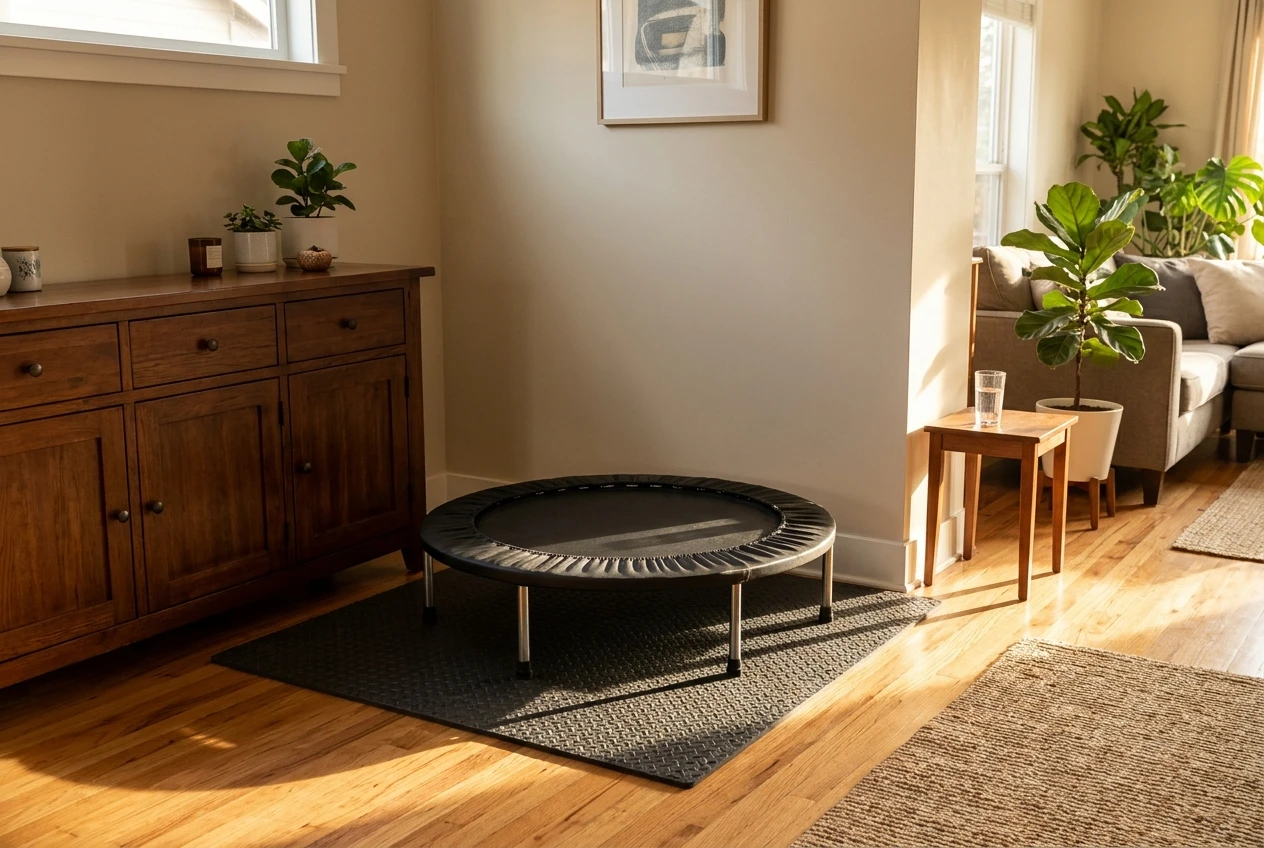
Set it up near a support. Even with a stability bar, it helps to place the rebounder near a wall or sturdy furniture, with clear space around it, so you have a second point of support if you need it.
Check the assembly. Follow the instructions in full. Tighten every bolt, confirm every hinge locks, and make sure the bar sits firmly. Recheck these after the first week and from time to time after that.
Start small. Begin with a few minutes of walking in place, holding the bar, and increase the time as you feel steady. Wear supportive footwear or grippy socks as recommended by the manufacturer, and keep a glass of water within reach.
Decide with a simple test. If you are torn between two models, ask three questions. Which one gives me the most stability? Which one can I store where I actually live? Which one will I still want to use in three months? The answer to the first question counts for the most when you are over 50.
Where to go next
Two companion guides on this site go deeper on the buying decision. How to Choose a Rebounder: The Only Checklist gives you a step-by-step list to work through before you order, and Buying a Rebounder After 50: What to Look For covers the points that matter most at this stage of life.
Once you know which type fits you best, use the “Check the current price and features” links on the models that match, and confirm the weight limit, the bar details and the folding or frame design before you buy.