
Does collagen help joint pain? The honest answer is that it might help a little, for some people, and the evidence is weaker than the labels suggest.
That is a more useful answer than a yes or no, because collagen is not expensive enough to be reckless or cheap enough to ignore.
I have been overweight and unfit myself, so I know how tempting a tub of powder is when your knees ache on the stairs.
Here is what the research can tell you, what it can’t, and where your effort is better spent.
Why Joints Start to Complain After 50
Joints are where two bones meet, cushioned by cartilage and held together by ligaments, tendons and muscle.
Over the decades, cartilage can thin and the tissue around the joint can stiffen.
The joint fluid, the muscles around it and the nerves that report pain all change with age too.
Pain is not simply a measure of damage, either.
Plenty of people with worn-looking joints on a scan feel fine, and plenty with ordinary scans hurt.
Several everyday factors feed into how a joint feels:
- Weak muscles around the joint, which leaves the joint absorbing more load
- Extra body weight, especially for knees and hips
- Long periods of sitting, which leave joints stiff
- Old injuries that were never fully rehabilitated
- Poor sleep, which lowers pain tolerance
Most of that list can be changed with training and habits, and none of it needs a supplement.
That matters when you weigh up collagen, because the supplement targets one small piece of a much bigger picture.
What Collagen Actually Is and What Happens When You Swallow It
Collagen is the most abundant protein in the body.
It forms part of skin, tendons, ligaments, bone and cartilage, which is why it sounds like the obvious thing to take for sore joints.
The problem is what happens after you swallow it.
Your digestive system breaks any protein down into smaller pieces, either short chains of amino acids called peptides or single amino acids.
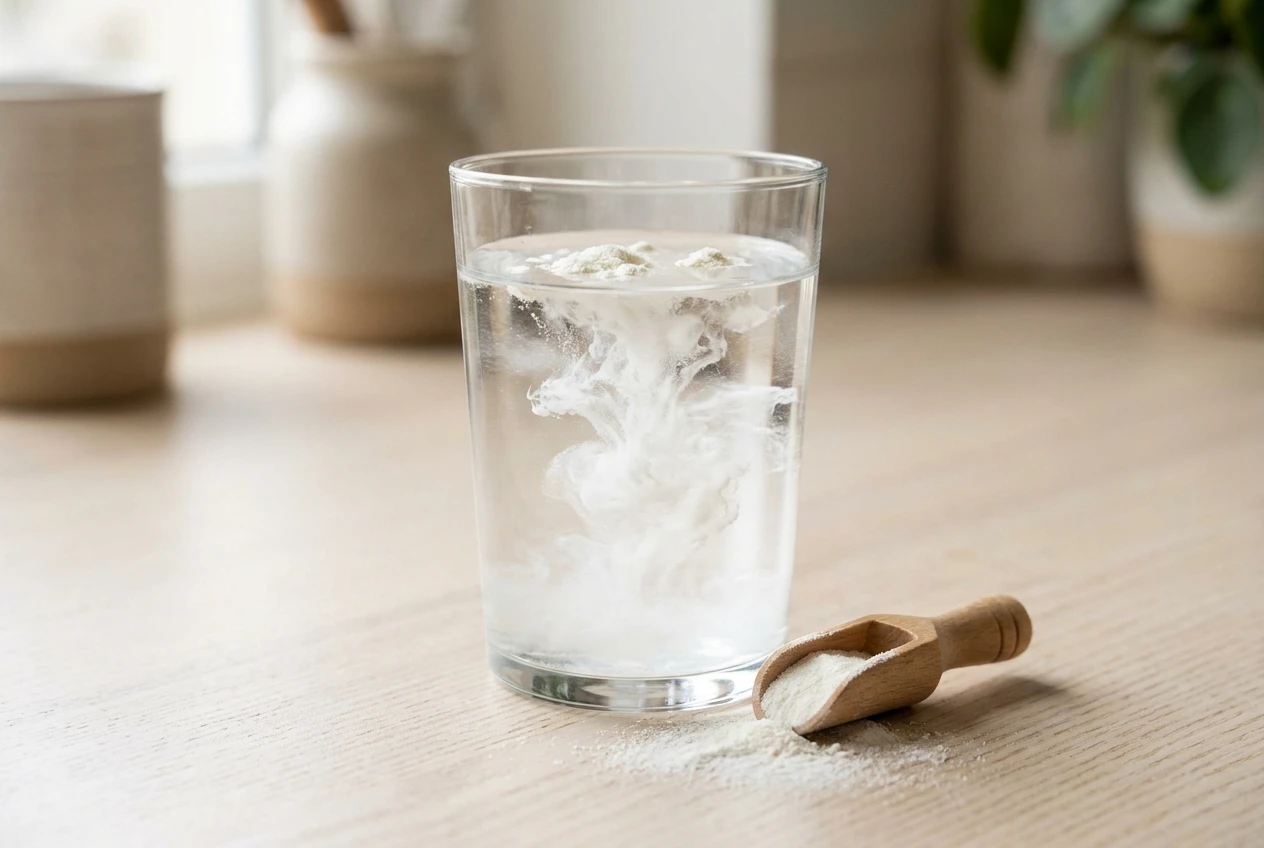
Those pieces enter the bloodstream and get used wherever the body needs them.
Collagen you eat is not delivered to your knee as collagen.
Most supplements are sold as hydrolysed collagen, also called collagen peptides, which means the protein has already been broken into smaller pieces so it dissolves easily.
Collagen is rich in the amino acids glycine and proline, and the body can also make these itself.
A second type, called undenatured type II collagen, is sold in very small doses and is meant to work through the immune system rather than as a building material.
It is a different product with a different proposed mechanism, so studies on one do not tell you about the other.
One more point is worth knowing: collagen is not a complete protein, because it lacks tryptophan.
It is a poor substitute for the protein in meat, fish, eggs, dairy or a good whey powder when your goal is keeping muscle.
What the Joint Pain Research Does and Doesn’t Show
Some trials, mostly in people with knee osteoarthritis or in active adults with joint discomfort, have found modest reductions in pain after taking collagen peptides for a few months.
Other trials found no meaningful difference from placebo.
Reviews that pool the studies tend to describe the evidence as promising but limited, and that is the fair summary.
There are several reasons to hold the findings loosely:
- Many studies are small
- Many run for only a few months
- A good number are funded or supplied by supplement companies
- Different studies use different products, doses and pain scales
- Pain scores improve on placebo too, so a small gain is hard to separate from expectation
None of that proves collagen does nothing.
It means the effect, if it exists, looks small and inconsistent.
Nothing in the research shows that collagen rebuilds worn cartilage in a person’s knee, and no honest label can promise it.
Phrases like “restores cushioning” or “lubricates your joints” are marketing language, not findings.
So does collagen help joint pain?
For some people it seems to take the edge off over a few months.
Nobody can yet tell you in advance who those people are.
Who Might Notice a Difference and Who Probably Won’t
People most likely to notice something are those with mild to moderate, ongoing aches and no sign of a more serious joint problem.
They are also the people willing to take it consistently for several months and judge it fairly.
A person with joint stiffness who already eats plenty of protein may see less benefit.
You probably won’t notice a difference if:
- Your pain comes from a recent injury or a mechanical problem like a torn meniscus
- Your pain is caused by an inflammatory condition that needs medical treatment
- You take it for two weeks and expect results
- You buy a product with a tiny dose of collagen mixed into a sugary drink
- You rely on it instead of moving more
There is also a group worth mentioning: people whose total protein intake is low.
If you eat very little protein, extra collagen will add some protein, but so would an egg or a tin of sardines, for less money.
If you are unsure whether you eat enough, work on that before you buy anything.
How to Choose a Collagen Supplement Without Overpaying
Some links on this site may earn a commission if you buy through them, at no extra cost to you. I only point you toward products I would be happy for you to compare on their merits.
If you decide to try collagen, the choice comes down to a handful of checks.
Collagen powders and capsules vary widely in price, and a higher price rarely means a better product.
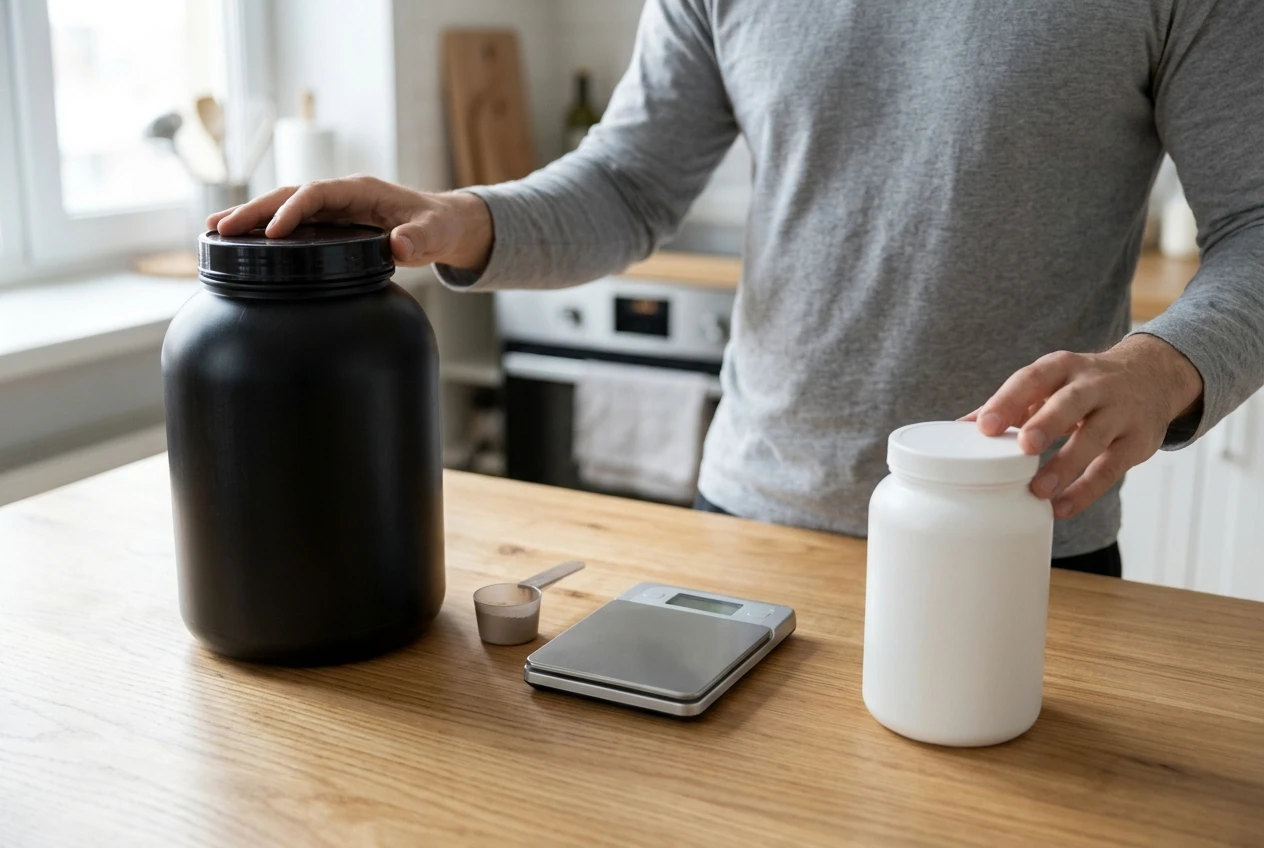
Look for these things:
- Hydrolysed collagen or collagen peptides: this is the form most joint studies used
- A clear amount per serving: a label that hides the dose in a “proprietary blend” tells you nothing
- Few extra ingredients: plain collagen is enough, and added vitamins, herbs and sweeteners raise the price
- Third-party testing: supplements are loosely regulated, so independent testing for purity and contaminants is a sensible reassurance
- The source: bovine, marine or chicken, and whether any of them clashes with an allergy, such as fish or shellfish
Compare the cost per gram of collagen rather than the cost per tub.
A cheap tub with a small serving size can cost more per useful gram than a larger one.
Powders are usually cheaper than capsules, because capsules hold small amounts and you need many of them.
Do not pay extra for claims about “beauty” or “anti-ageing” blends if joints are your reason for buying.
If you take regular medication or have a medical condition, check with your doctor or pharmacist before adding any supplement.
What Does More for Sore Joints: Strength, Protein and Rest
If I had to put money on one thing for achy knees, hips and hands, it would be stronger muscle, not a tub of powder.
Muscles act as shock absorbers and stabilisers for the joints they cross.
Stronger thighs and hips share the load that would otherwise fall on a knee.

Strength training also helps you manage body weight, and every extra kilogram adds to the load your knees and hips carry when you walk.
Starting does not require heavy barbells or a gym full of kit.
The routine I recommend is three short, hard workouts a week on non-consecutive days, such as Monday, Wednesday and Friday.
Split them into legs, then shoulders and back, then chest and arms.
A few principles keep it joint-friendly:
- Put technique before weight, every time
- Use machines or dumbbells if a barbell feels awkward
- Stop each set with one or two reps still in reserve at first
- Add weight only when the last set of an exercise feels controlled
- Give a routine a proper run before you change it
That structure is laid out in full in the 3-day, 30-minute plan linked at the end of this article, which is the worked example I would point any beginner to.
Protein matters because muscle needs it to repair and grow.
I compared the practical options in protein powder vs whole food for building muscle after 50, and the short version is that total daily protein counts more than the source.
Rest matters as well, because joints and muscles adapt between sessions rather than during them.
Sleep, rest days and sensible protein intake are covered in my guide to how to recover after 50.
Compared with all of this, collagen is a small add-on at best.
A Sensible Way to Test Collagen for Yourself
If you would still like to try it, a simple trial tells you far more than a testimonial on a label.

Follow these steps:
- Rate your joint pain from 0 to 10 for a week before you start, noting which joint and which activity, such as stairs or gripping a jar.
- Choose one plain hydrolysed collagen product and follow the serving size on the label.
- Take it daily for around twelve weeks, since trials generally run for months rather than weeks.
- Re-rate your pain once a week, using the same scale and the same activities.
- Compare the last few weeks to your starting week.
Keep everything else steady while you test.
If you begin strength training at the same time, you will not know which one helped, so be aware that the exercise itself may be responsible for any improvement.
That is a good problem to have, but it does mean the result tells you less about collagen.
Decide in advance what counts as worthwhile, for example a drop of two points on your scale in the activity that bothers you most.
If you do not reach it after twelve weeks, stop buying it and put the money toward food or equipment that helps you train.
Stop sooner if you get stomach upset, a rash or any reaction.
When Joint Pain Needs a Doctor, Not a Supplement
Supplements are for ordinary, mild, long-standing aches.
Some symptoms need a medical opinion first.
Book an appointment if you notice:
- A joint that is hot, red or visibly swollen
- Pain after a fall or injury
- A joint that locks, gives way or will not take your weight
- Pain that wakes you at night or is present at rest
- Morning stiffness that lasts for more than half an hour
- Fever, unexplained weight loss or general illness alongside joint pain
- Pain that is getting steadily worse
Many causes of joint pain, including osteoarthritis, inflammatory arthritis and gout, have effective treatments, and some need to start early.
A doctor or physiotherapist can also tell you which exercises are safe for your particular joint.
Taking a supplement and waiting is the wrong response to those warning signs.
Where to Go From Here
Collagen is a reasonable thing to try for mild joint aches if you go in with modest expectations, a clear test and a sensible budget.
The research gives it a small, uncertain benefit, and it gives strong, consistent support to staying active and building muscle.
Whatever you decide about the tub, the muscle around your joints is the part you can improve for certain.
Read the 3-day, 30-minute plan to start building the muscle that supports your joints.